


On the eve of International Women’s Day, the role of women in the economy is being discussed more and more frequently. While just a few years ago women’s entrepreneurship was viewed primarily as a social initiative, today it is becoming one of the noticeable drivers of economic growth. Women are starting businesses, managing companies, creating jobs, and increasingly using financial tools to develop their projects.
According to industry studies, data from international organizations, and Octobank analytics, women’s participation in Uzbekistan’s economic and financial system continues to grow steadily. Millions of women actively use banking services, digital payments, and financial tools to manage personal income, savings, and everyday financial transactions. Experts note that the growth of financial activity often becomes one of the factors stimulating the development of the entrepreneurial environment — from launching a business and developing family enterprises to scaling small projects.
As part of preparations for International Women’s Day, Octobank analyzed customer statistics and compared them with national economic data to assess the level of women’s financial activity and its impact on economic processes in the country.
The analysis shows that women demonstrate steady growth in their engagement with financial services and increasingly use banking tools to manage income, savings, and payments. This dynamic is becoming an important factor in the development of the entrepreneurial environment: the availability of digital banking services lowers barriers to starting a business and simplifies the management of financial flows.
Experts emphasize that the development of digital financial infrastructure is becoming one of the key factors in expanding economic opportunities for women. Modern banking services allow new projects to be launched faster, enable efficient working capital management, and help control financial operations more effectively.
Against this backdrop, women’s entrepreneurship in Uzbekistan is gradually becoming one of the most dynamic segments of small business. The growth of women’s financial inclusion contributes to the development of entrepreneurial activity, the creation of new jobs, and the emergence of sustainable economic initiatives in the regions.
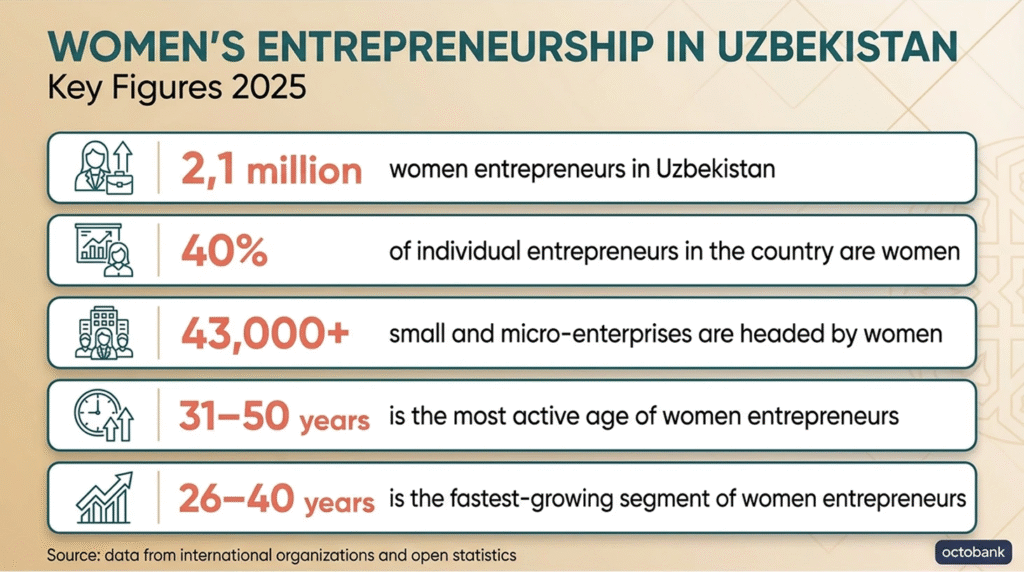
As of 2025, Uzbekistan has developed a large entrepreneurial ecosystem with active participation by women. According to industry research and data from international organizations, the country has more than 2.1 million women entrepreneurs, and women own about 40% of all registered individual businesses. In addition, women manage more than 43,000 small and microenterprises operating in various sectors of the economy — from trade and services to manufacturing and creative industries.
Statistics from the banking sector confirm these trends. According to aggregated Octobank data, women account for about 34% of the bank’s customer base, reflecting their high level of engagement in the country’s financial infrastructure.
The age structure of financial activity demonstrates a characteristic pattern. The most active category among women is the 41–50 age group, followed by the 36–40 and 31–35 groups. These age segments show the highest levels of banking product usage and financial transactions.
At the same time, activity is also growing among a younger audience — aged 26–40 — characterized by active use of digital financial services, mobile banking applications, and income management tools. This reflects the broader trend of financial service digitalization and the gradual transition of entrepreneurial activity into the online environment.
Women’s entrepreneurship is gradually moving beyond the social agenda and becoming a full-fledged economic factor. Companies led by women actively contribute to shaping the domestic market, creating jobs, and supporting the development of small and medium-sized businesses.
Experts note that women’s entrepreneurial activity is particularly visible in sectors such as trade, services, education, creative industries, and light manufacturing. In several regions of the country, women-led enterprises are becoming drivers of local economic development and employment.
At the same time, government policy and reforms in recent years have significantly improved conditions for entrepreneurship. The expansion of small business support programs, the development of digital government services, and the simplification of business registration procedures are contributing to the growth of entrepreneurial initiatives among women.
Octobank experts emphasize that the development of banking infrastructure plays an important role in this process.
“Financial statistics show that women’s participation in Uzbekistan’s economy is steadily growing. We see this in everyday banking operations: women actively use digital services, manage their personal finances, and increasingly make key economic decisions. For the banking sector, this means the need to create a convenient and technologically advanced financial infrastructure that supports economic activity,” the Octobank analytical department notes.
Octobank analytics and national statistics show that women’s entrepreneurship is becoming an important element of Uzbekistan’s economic structure. The growing number of women entrepreneurs, expanding access to financial instruments, and active use of digital services are shaping a new entrepreneurial environment.
As banking technologies and small business support programs continue to develop, the role of women in the country’s economy will keep strengthening, making women’s entrepreneurship one of the key factors of sustainable economic growth.
